
Digital Citizenship and Artificial Intelligence
The morning is devoted to the talks with the speakers; the afternoon to a hands-on workshop building an automated tool that selects the best opportunities for young people every week, then donating it to a local organisation.
The day at a glance
Attending the event? Register in a minute: a few details help us organise the welcome desk and the project’s research.
Register for the event
 Scan the QR code with your phone to register
Programme
| Time | Session | Content |
|---|---|---|
| 10:00 – 10:30 | Welcome and registration | Arrival of participants, registration and distribution of the day’s materials. |
| 10:30 – 10:45 | Opening | Presentation of the day, of the local context and of the collaboration with Monaci Digitali APS. |
| 10:45 – 11:15 | Paolo Diana | Scientific and project framework of PARTECIPA: objectives, action-research method, the role of DISUFF and prospects for youth participation. |
| 11:15 – 11:55 | Paolo Landri | Nomadic subjectivities across digital cultures, democracy and ecology: how digital technologies reshape identity, political participation and our relationship with the environment, between spaces of emancipation and forms of control. |
| 11:55 – 12:35 | Giovannipaolo Ferrari | Public sociology, digital citizenship and AI: young people, digital media, platforms, disinformation, rights, duties and civic participation. |
| 12:35 – 13:30 | dialogue with the audience | Plenary discussion, questions from participants and collection of ideas for the afternoon workshop. |
| 13:30 – 14:30 | Lunch break | An informal moment of exchange between participants, speakers and organisers. |
| 14:30 – 14:55 | Case study — Reunivo | How artificial intelligence, used methodically and in compliance with health data regulations, can address a real social need. By Luigi Garone — Logika.studio, creator of Reunivo and technical partner of the project, and Rita Tierno, CEO of Reunivo. |
| 14:55 – 15:10 | Introduction to the workshop | Presentation of the day’s project — «The opportunities radar» — and of the tools that will be used: Google Sheets and Apps Script, Gemini in its free version, all with no installation and no cost. The workshop is free but has limited places: 20 participants selected among those attending in the morning. |
| 15:10 – 17:00 | Guided workshop — The opportunity radar | Step-by-step joint construction of an automation that every week searches public portals on its own for calls and opportunities open to young people, rewrites them in plain language and prepares the digest to be delivered locally. Led by Luigi Garone (Logika.studio). |
| 17:00 – 17:20 | Presentation and hand-over | First live send of the weekly digest and presentation of what we built — what it does, who receives it, what it cannot do — with hand-over of the sheet to the receiving public office. |
| 17:20 – 17:45 | Closing discussion | Collective synthesis, links with the MOOC and with the next activities of the PARTECIPA project. |
| 17:45 – 18:00 | End of the day | Final greetings and instructions for filling in the questionnaire and for the project follow-up. |
How we work: method and tools
The morning is a public seminar session. Three talks — the scientific and project framework of PARTECIPA, nomadic subjectivities between digital cultures and democracy, public sociology between digital citizenship and artificial intelligence — build the shared framework of the day, in language designed also for those without a background in sociology. It ends with the dialogue with the audience: questions, objections and ideas from the audience are collected and carried into the afternoon session, so that the lab work starts from the issues raised in the room and not from a topic decided in advance. Admission to the seminar sessions is free and there is no limit on places.
The afternoon is not a lecture nor a theoretical discussion: it is a guided building workshop. We all work together on a single project — «The opportunity radar» — and by the end of the day what we have built is not a demo, but an automation that keeps running by itself every week and is handed over to a local public office. The session is guided step by step: nobody is left behind and no technical skills are required. The lab is also free, but with limited places: places are 20 and participants are selected from those attending in the morning.
We are not building yet another assistant to ask questions to — those are everywhere by now — but an «agent» that works on its own: it reads the funding portals for us, discards what does not concern local young people, rewrites what is left in plain language and delivers it to those who need to know. The tools are free and already available to anyone with a Google account: a spreadsheet, Google’s automation (Apps Script) that runs it every Monday, and the free version of the Gemini model, which reads and rewrites.
The method sets three rules: never enter real personal data into the tools we use; every piece of information carries the link to its official source, and deadlines are always checked by hand before being communicated; nothing goes out to citizens automatically — every send is approved by a person in the office. The work closes by stating the limits: what the agent cannot do, where it can go wrong, who supervises it and how often.
Speakers and talks
Paolo Diana
Professor of Sociology, University of Salerno – DISUFF; scientific coordinator of the PARTECIPA project.
Scientific and project framework of PARTECIPA
The talk introduces the scientific and project framework of PARTECIPA. Public sociology, digital citizenship and civic participation in the Campania Region, presenting its objectives, its methodological design and its local roots. The project stems from the need to strengthen the relationship between the university, young people, institutions and local communities, promoting training, action research and civic participation on digital citizenship, the informed use of technology and public responsibility. In this perspective, DISUFF at the University of Salerno plays a central role as a space for scientific elaboration, institutional coordination and support of the training and workshop activities. The talk highlights the link between public sociology, young people and digital transformations, showing how sociological research can move beyond academic boundaries to become a tool for listening, co-design and action in local areas. PARTECIPA is thus presented as a path able to connect scientific knowledge, civic education, digital skills and democratic participation.
Paolo Landri
Research director at the Italian National Research Council; acting director of IRISS-CNR.
Nomadic subjectivities across digital cultures, democracy and ecology
The talk explores the concept of «nomadic subjectivity» as an interpretive key to the contemporary transformations generated by the intersection of digital cultures, democracy and ecology. Starting from this conceptual figure, it analyses how digital technologies reshape the ways in which identity, political participation and our relationships with the environment are built, producing subjects who are increasingly mobile, interconnected and crossed by multiple cultural belongings.
In this scenario, digital cultures are at once a space of emancipation and of control: they foster new collaborative practices, knowledge networks and forms of active citizenship, but they also raise questions about surveillance, disinformation and inequalities in access to technology. Democracy is therefore called to engage with participatory models in constant evolution, in which the plurality of voices and the global circulation of information redraw the boundaries of political action.
At the same time, the ecological crisis calls for a revision of the relationship between human beings, technology and nature, promoting a relational and interdependent conception of living things. From this perspective, nomadic subjectivity becomes an ethical and political paradigm able to move beyond anthropocentric visions and rigid identities, guiding practices of shared responsibility and sustainability.
The aim of the talk is to bring these three areas into dialogue, showing how nomadism is a useful interpretive category for understanding the challenges of the present and imagining innovative forms of democratic coexistence, ecological justice and digital citizenship.
Giovannipaolo Ferrari
Researcher in Sociology, University of Salerno – DISUFF; coordinator of the scientific and workshop activities of the project.
Public sociology, digital citizenship and AI
The talk offers a reflection on the relationship between public sociology, digital citizenship and artificial intelligence, with particular attention to the way young people, digital media and platforms are redefining the forms of information, participation and public responsibility. Starting from the changes introduced by generative AI tools, it examines the skills needed to inhabit digital environments consciously: recognising disinformation, critically assessing sources, understanding how platforms work, protecting one’s rights online and behaving responsibly in the digital public space. In this perspective, digital citizenship is not only about access to technology, but about the ability to use it critically, ethically and participatively. The aim is to show how public sociology can offer interpretive and practical tools to turn AI from a mere consumer technology into an opportunity for civic education, democratic awareness and social participation.
Case study — Reunivo
A cura di Luigi Garone – Logika.studio, ideatore di Reunivo e partner tecnico del progetto PARTECIPA.
With Rita Tierno, CEO of Reunivo.
When a citizen uses artificial intelligence to address a social need
A platform born from the initiative of a single person: data quality, compliance with the rules that protect people, and responsibility for the final decision, which always remains human. Go to reunivo.eu
Reunivo is a project created by Luigi Garone (Logika.studio); Rita Tierno is its CEO.
The afternoon project: «The opportunity radar»
Opportunities for young people do exist — regional calls, European funds, civil service, grants, residencies, calls from associations — but they are scattered across dozens of different portals, written in administrative language and with deadlines that go unnoticed. Those who would benefit most often never see them; public offices, for their part, have no time to monitor every source every week.
Together we build an automation that every Monday morning reads the portals we have listed, keeps only what concerns local young people, rewrites each call in five readable lines — who can apply, what is needed, by when, how much it is worth, official link — and prepares a digest ready to be sent. Someone in the office reads it, approves it and forwards it to associations, schools and young people.
The result keeps working after the event. The automation lives in the organisation’s own account, costs nothing and is handed over with a sheet explaining which sources it watches, what it does not do, who approves the sending and how to add or remove a portal. Not a prototype to show: a service that restarts by itself every week.
The tools we will use
Stated upfront, all free, used from the browser: no installation, no subscription, no programming skills. All you need is a phone or a laptop per group, an internet connection and a free Google account.
Google Sheets + Apps Script
Google · free, from the browser
The engine of the radar: the spreadsheet collects the opportunities found, the script goes and fetches them and an automatic trigger restarts it every Monday morning, with nobody having to remember. It runs inside the organisation’s own Google account.
Gemini API, free version
Google · free key, no credit card
The intelligence that reads: it tells a call that concerns young people from one that does not, extracts the five facts that matter and rewrites the administrative text in plain language.
Gmail and Google Groups
Google · free
The delivery: the weekly digest reaches the office first, which approves it, and then the list of local associations, schools and young people.
Your phone or laptop
One per group, with an internet connection
No installation, no paid account, no technical skills: we bring the starting documents and the session is run step by step.
How we proceed, step by step
-
15:10 – 15:30
The sources and the recipients
Together we choose the portals to watch — Regione Campania, Sviluppo Campania, the Youth Policy Department, Eurodesk, municipal notices — and decide who should receive the digest.
-
15:30 – 15:50
What really matters
We define the five fields of the record (who can apply, what is needed, by when, how much it is worth, official link) and the criteria for discarding what does not concern local young people.
-
15:50 – 16:20
Building the agent
We connect spreadsheet, automation and model: the agent reads the portals, fills the table by itself and rewrites each call in plain language.
-
16:20 – 16:45
The test that matters
We run it on real calls and check deadlines, requirements and amounts against the source: every error and every made-up detail must be noted.
-
16:45 – 17:00
Launch and hand-over
We switch on the weekly trigger, send the first digest to everyone in the room and fill in the hand-over sheet for the office.
What you need to take part
- A phone or a laptop per group — one working device is enough; whoever does not have one works with someone who does.
- A free Google account (the one you use for Gmail is fine). If you do not have one, we create it in the room in two minutes.
- No technical skills: no coding required, nothing to install, everything is done from the browser.
- No personal data: we only work on public documents. We bring the starting materials.
- Pen and paper, if you prefer taking notes by hand: the workshop worksheet has a space for them.
The workshop is run step by step by Luigi Garone (Logika.studio), technical partner of the project: everyone works on the same project, so that nobody is left behind and the result is a single tool that can really be used. The receiving office and the final list of monitored portals are agreed with local institutions before the event.
The result: the radar is online, and anyone can copy it
The workshop ended with the automation working and handed over to a local public office. From today «The opportunity radar» is also public and open: the code is on GitHub under the MIT licence, the sheet is duplicated with one click and the step-by-step guide used in the classroom is available in Italian and English. Those who were not in the room can rebuild it for their own town, school or association.
Materials of the day
The full programme and the workshop worksheets, in PDF: the same materials handed out to participants on site.
- Programme of the day Times, method, admission rules, the full abstracts of the three talks, the case study, the workshop outline and the afternoon project with the tools declared.
- Workshop worksheet Method, tools, phases with their times and the sheet handed over with the automation to the receiving office.
- Abstract of Paolo Landri’s talk «Nomadic subjectivities across digital cultures, democracy and ecology»: the full text provided by the author.
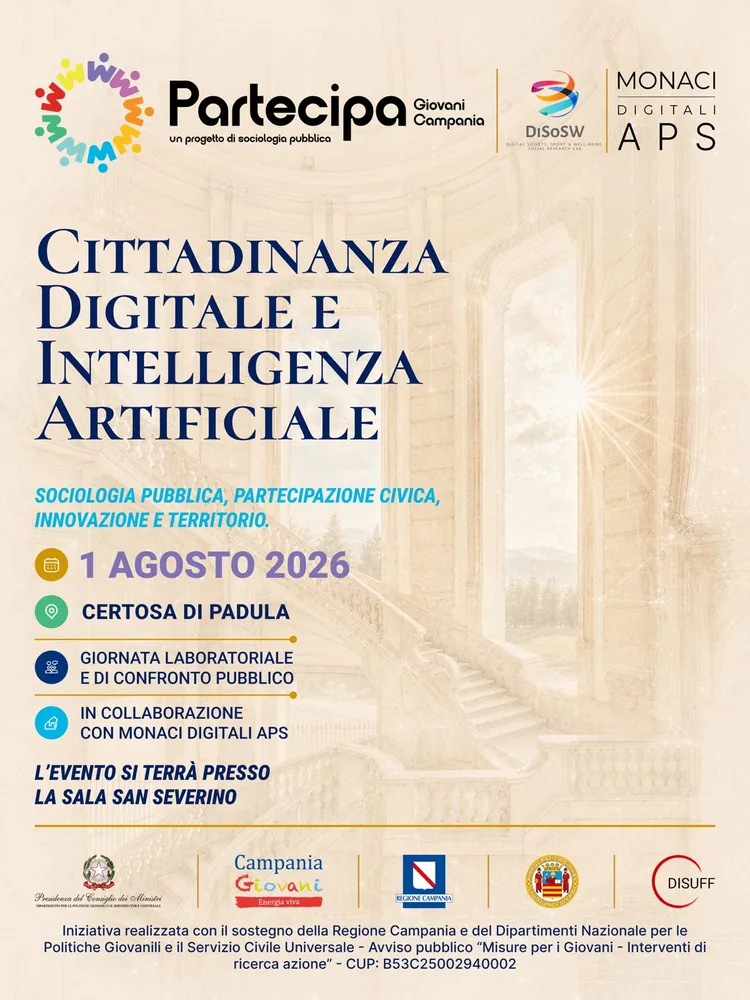
- Event poster An image to share and print to spread the word about the event.
- Step-by-step guide of the workshop Rebuild «The opportunity radar» on your own: ten steps with screenshots and the code to paste. Bilingual Italian/English.
Everything the groups built during the afternoon is published in full on the opportunity radar page, together with the source code and the sheet to copy.
Your feedback on the day
Your feedback matters. If you attended the day on 1 August, help us improve PARTECIPA’s activities: fill in the satisfaction questionnaire — it only takes a few minutes.
Practical information
The event takes place at the Certosa di San Lorenzo in Padula (SA), in the Sala San Severino. Attendance is free of charge; registering helps us organise the welcome desk and collect research data. For the afternoon lab it is useful to bring a laptop or a phone.
How admission works. Le morning seminar sessions have free entry and no limit on places: anyone can take part. The afternoon workshop remains free of charge but has limited places: the places available are 20 and participants are selected from those attending in the morning. If you are interested in the workshop, please come in the morning and let the welcome desk know.